THE UTAH TINT GUIDE 01 / KNOW YOUR SHADE
Utah window tint.
Find your shade.
Utah window tint laws, percentages & practical advice. Find the right balance of privacy, comfort, and visibility before you pick your shade.
Law checked October 1, 2026 · Utah Code § 41-6a-1635
01 / THE RULES
What’s legal in Utah?
Start with the window position. These are Utah vehicle-operation limits; professional installation must also comply with applicable federal glazing standards.
Driver & front passenger
At least 35% visible light transmission (VLT) through the finished window. The law includes a 5% variance for a peace officer’s meter reading; aim for compliance, not that tolerance.
The main viewing area
At least 70% light transmission. A film marked “70” can fall below that once added to your glass. Have the finished windshield measured.
Rear sides & rear glass
No Utah minimum VLT for rear windows. Even 5% is an option under state law, with left and right rear-view mirrors. Legal darkness can still reduce visibility.
Utah also prohibits a metallic or mirrored appearance. Read the official statute ↗ · *Rear windows only; see the windshield-strip exception below.
15%, 25%, and 5% are rear-window choices.
They are below Utah’s front-side minimum. The darker recommendations in this guide apply to rear windows, not the driver or front passenger doors.
02 / LESS LIGHT, MORE SHADE
What does the percentage mean?
VLT is how much visible light gets through. Lower numbers mean darker glass. A 5% window admits one fifth as much visible light as a 25% window under the same conditions.
Swatches illustrate relative darkness; they are not measured samples. Film shade names and actual installed VLT can differ.
Film + factory glass = the final reading
The percentage on the film box is not necessarily your finished window’s VLT. As a rough estimate, multiply the glass transmission by the film transmission: 80% glass × 50% film ≈ 40% combined VLT. That same glass with 35% film ≈ 28%.
A meter reading on the finished window is the deciding check. Factory privacy glass, existing film, and the product’s measured specifications all matter. Use film-only VLT in this estimate; some manufacturer charts already include test glass, so multiplying those values again can double-count it.
03 / SEE THE TRADE-OFF
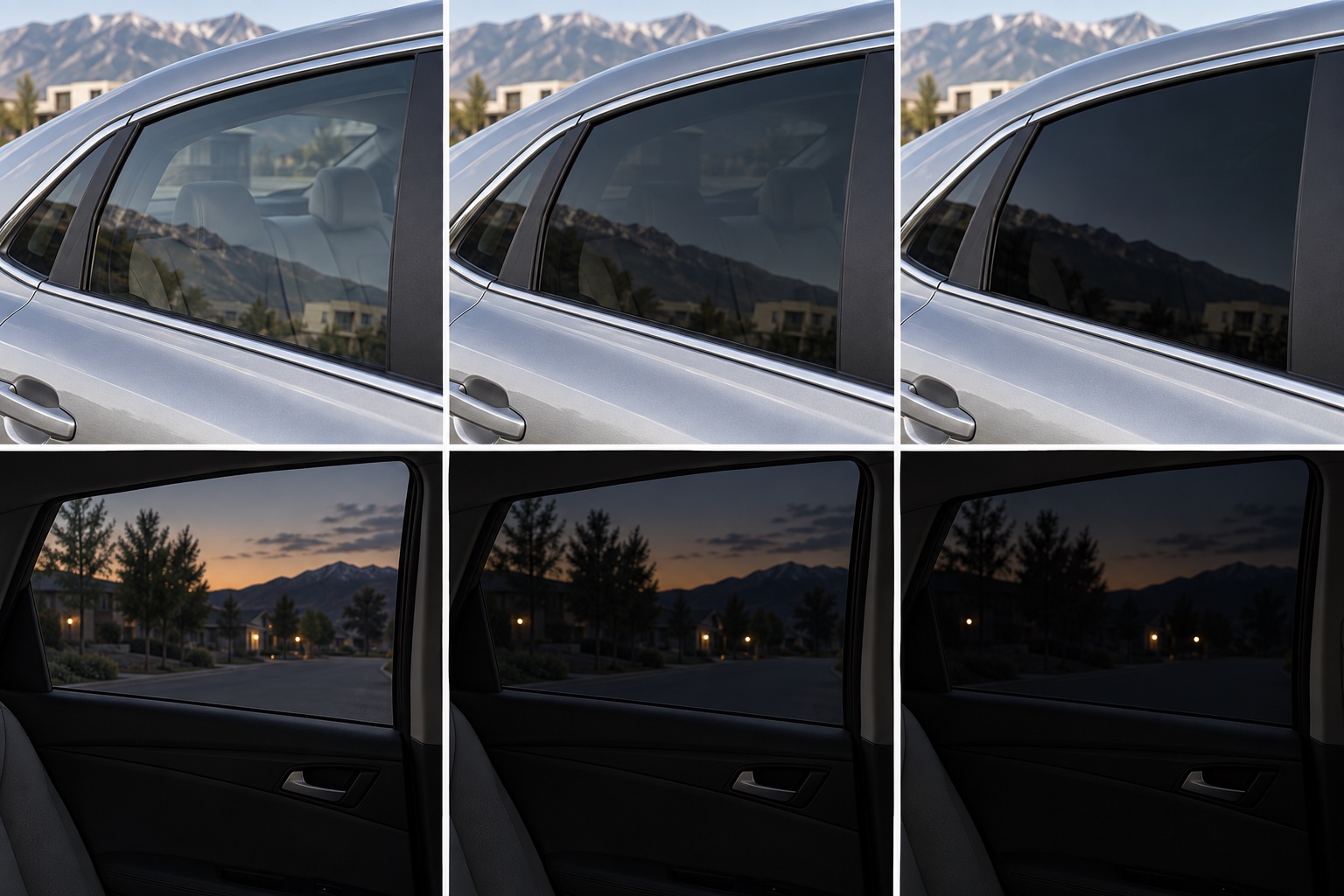
The look outside.
The view from inside.
Compare three rear-window shade concepts in daylight and at dusk. More privacy means less visible light reaching your eyes, too.
DAYLIGHT · VIEW FROM OUTSIDE
DUSK · VIEW FROM INSIDE A REAR SIDE WINDOW
AI-generated educational illustrations, not client vehicles, actual installations, or calibrated VLT demonstrations. Actual visibility depends on glass, film, weather, lighting, eyesight, and exposure. A screen cannot show you what your eyes will see; compare real samples before choosing.
Open the full-size shade illustration ↗
5% can be hard to see through at night.
Dark tint reduces already limited light on unlit streets. Rearward checks, reversing, and spotting people or obstacles can become harder. Ceramic film does not cancel this trade-off. NHTSA explains the low-light visibility concern ↗
If you regularly drive after sunset, start lighter. 25% admits more visible light than 15%; both admit more than 5%. Even these lighter rear shades can affect nighttime visibility.
Privacy is not a one-way guarantee.
15% and 25% can make the cabin harder to see into in daylight, but neither makes it invisible. Bright interiors, a sunroof, viewing angle, or an interior light at night can reveal what’s inside.
Ordinary automotive tint reduces light in both directions. Its privacy effect changes with the lighting difference between the cabin and outdoors.
04 / PICK FOR YOUR ACTUAL DRIVE
Our practical shade recommendations
These are starting points for a conversation, not universal safety ratings. Try real film samples on your vehicle and consider your night driving.
EVERYDAY BALANCE
Legal fronts.
25% rear concept.
Keep fronts compliant after measurement. Start around 25% on rear glass for a shaded look with more transmitted light than 15% or 5%.
Our starting point for mixed day / night usePRIVACY FIRST
Legal fronts.
15% rear concept.
A darker rear cabin in daylight, with a noticeable visibility trade-off. Consider it only after evaluating real samples, especially after dark.
Darker appearance · lower light transmissionFREQUENT NIGHT DRIVING
Go lighter.
Keep the view.
Consider 35%, 50%, or lighter on rear windows, and lighter compliant fronts. Match the shade to your eyesight and the roads you use.
Prioritize visibility over maximum privacyWhere does 5% fit?
Utah’s rear-window rules allow it, but it is not our everyday starting point. Choose it only with a clear understanding of reduced nighttime visibility. It will not deliver perfect privacy in every lighting condition.
You don’t have to go dark for heat control.
Some lighter ceramic or spectrally selective films reject substantial solar energy. Compare the actual product’s total solar energy rejected (TSER), VLT, and UV data rather than choosing by darkness alone.
05 / THE WINDSHIELD EYEBROW
A sun strip.
Keep it out of your sightline.
An eyebrow is the narrow strip along the top of the windshield. Its size and placement matter as much as its darkness.
How far down can it go?
Utah permits nontransparent material along the top edge up to four inches from the top or the manufacturer’s AS-1 line, “whichever is lowest.” That means the lower of those two physical marks. Have your installer identify and measure the boundary on your vehicle.
How dark should it be?
The state’s top-strip exception permits nontransparent material, so it does not set a minimum VLT within that permitted strip. A 5% eyebrow is a very dark option; 15–25% offers a less dark strip. These percentages do not apply to the rest of the windshield.
Our recommendation: keep it shallow and above your normal forward view. Start with a 15–25% strip concept if you want a less dark result, then evaluate from your driving position. Consider 5% only if the strip stays out of your sightline. Placement is more important than chasing the darkest look.
BEFORE YOU BOOK
A few things worth clearing up
Is 35% film automatically legal on the front?
No. Utah’s threshold applies to light transmission through the window. Factory glass reduces light before film is added. Choose using the combined reading, with room for product variation, and verify with a meter.
Does Utah have different rear tint limits for sedans and SUVs?
The state provision permits nontransparent material on rear windows behind the operator without a separate sedan/SUV VLT chart. Applicable federal installation rules can depend on the vehicle and window position.
Can a doctor’s note let me choose darker fronts?
The current Utah tint section does not provide a medical exemption. Do not assume a doctor’s note authorizes darker tint; check directly with Utah authorities before relying on an exception.
Will ceramic 5% tint let me see out like lighter film?
No. Ceramic describes the film technology, not a way around visible light transmission. A 5% finished window still transmits far less visible light than a 25% finished window.
What if I already have factory privacy glass?
Measure it first. Applying more film can make the finished window much darker than the film label suggests. A lighter film may offer the comfort benefits you want without making rear visibility unnecessarily difficult.
CHECKED, NOT GUESSED
Sources & scope
Reviewed October 1, 2026. Legal summary based on the current Utah Code section, effective May 7, 2025, and Utah Highway Patrol’s 2025 inspection manual. Practical shade choices are our editorial recommendations, not legal requirements or guarantees of visibility.
- Utah Code § 41-6a-1635 · Official PDF — state window limits, strip exception, mirror requirement, and federal-standard provision.
- Utah Highway Patrol inspection manual — windshield and tint measurement guidance, printed pages 35–36.
- LLumar automotive film specifications — VLT, solar-energy rejection, and lighter film options. Product reference, not a claim that we install this brand.
- NHTSA glazing interpretation — general low-light visibility principle; this older interpretation is not a Utah-specific shade recommendation.
YOUR CAR. YOUR COMMUTE. YOUR SHADE.
Let’s choose tint that fits your drive.
Tell us about your vehicle, the look you want, and how much you drive at night. We’ll help you compare film options and check the finished glass.